CD38 & NAD+: Key to Longevity Medicine
Longevity Medicine, CD38, NAD+, Healthy Ageing
CD38 in Longevity Medicine: The Critical Connection to NAD+
CD38 has emerged as a central player in the biology of ageing, largely because of its powerful impact on the vital coenzyme NAD+. As longevity medicine moves from theory to clinical practice, understanding the CD38–NAD+ connection is becoming essential for clinicians, researchers and health-conscious individuals seeking to preserve function and healthspan rather than simply extend lifespan.
NAD+: A Central Currency of Cellular Ageing
Nicotinamide adenine dinucleotide (NAD+) is often described as a cellular “energy currency”, but this label understates its breadth of influence. Beyond its classical role in redox reactions and ATP production, NAD+ is a critical signalling molecule, acting as a substrate for multiple enzyme families involved in DNA repair, epigenetic regulation and stress responses. Mechanistic reviews published up to 2026 now position NAD+ as a central metabolic hub linking many of the recognised hallmarks of ageing, from genomic instability and epigenetic drift to mitochondrial dysfunction and altered intercellular communication (Mechanisms of Ageing and Development, 2026).
At the mitochondrial level, NAD+ is indispensable for oxidative phosphorylation and efficient ATP generation. Reduced NAD+ availability compromises electron transport chain function, contributing to the well-characterised decline in NAD+ and mitochondrial health seen in aged or metabolically stressed tissues in animal models. In parallel, nuclear NAD+ fuels sirtuins and PARPs, enzyme families that orchestrate DNA repair, chromatin structure and metabolic adaptation. When NAD+ is scarce, these protective systems are forced to compete, and long-term genomic maintenance may be sacrificed in favour of short-term survival.
📌 Key Takeaway: NAD+ is not merely an energy cofactor; it is a master regulator of cellular resilience and repair, making it a prime target in longevity medicine.
Does NAD+ Decline with Age? A Nuanced Picture
The concept of NAD+ decline in ageing has become almost axiomatic in longevity circles. Numerous rodent studies demonstrate a consistent fall in tissue NAD+ with age, accompanied by impaired metabolic function, increased inflammation and reduced stress tolerance. Restoring NAD+ in these models often improves mitochondrial performance, physical endurance and markers of healthspan, and in some cases modestly extends lifespan (Ageing Research Reviews, 2026).
Human data, however, are more complex. A Finnish study using refined measurement techniques reported that blood NAD+ levels remain broadly stable across healthy ageing, yet are significantly lower in individuals with cancer, Alzheimer’s disease and Parkinson’s disease, and show modest declines in skeletal muscle (NAD.com, 2026). This suggests that pathological ageing and chronic disease may be more tightly coupled to NAD+ loss than chronological age alone. In other words, “NAD+ decline ageing” might be better framed as “NAD+ decline in unhealthy ageing”.
Nonetheless, even relatively subtle reductions in tissue NAD+ could have outsized consequences over decades, particularly in high-demand organs such as brain, heart and muscle. This has driven intense interest in how NAD+ homeostasis is regulated – and why, in many models, it deteriorates with age. At the centre of that discussion sits CD38.
CD38: The Enzyme Linking Immunity, Inflammaging and NAD+ Loss
CD38 is a multifunctional ectoenzyme expressed on the surface of many immune and stromal cells. From the perspective of longevity medicine, its most important property is its activity as a major NAD+ glycohydrolase: CD38 breaks down NAD+ into nicotinamide and ADP-ribose, and can also generate cyclic ADP-ribose, a signalling molecule regulating calcium dynamics. Several reviews now identify CD38 as one of the dominant consumers of NAD+ in mammalian tissues (PMC7359700; AJP-Endocrinology, 2020).
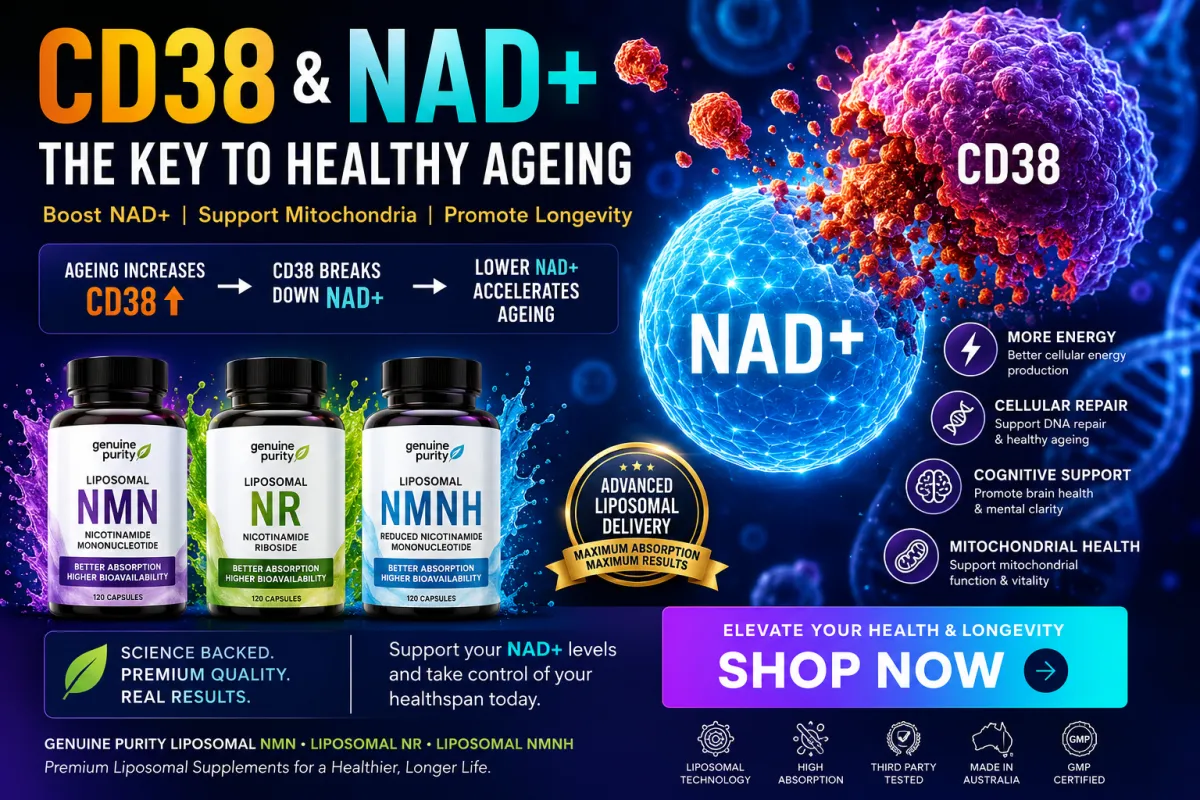
Crucially, CD38 expression and activity rise with age, particularly in inflammatory and senescent cell populations. This creates a mechanistic bridge between CD38 and longevity: as CD38 activity increases, it accelerates NAD+ degradation, reducing the pool available for sirtuins, PARPs and mitochondrial metabolism. The result is a biochemical environment that favours cellular dysfunction, low-grade inflammation and impaired stress responses – all features of biological ageing.
💡 Pro Tip: When evaluating NAD+ status in ageing, it is not enough to ask how much NAD+ is produced; it is equally important to consider how rapidly it is being consumed by enzymes such as CD38.
The CD38–NAD+ Connection: A Double-Edged Sword in Ageing Biology
The CD38 NAD+ connection illustrates the trade-offs that characterise many ageing pathways. On the one hand, CD38-mediated NAD+ breakdown supports immune cell activation and calcium signalling, which are essential for host defence and tissue repair. On the other, chronic upregulation of CD38 – particularly in the context of persistent low-grade inflammation – can become maladaptive, draining NAD+ reserves and undermining long-term cellular maintenance.
Preclinical studies in mice have shown that genetic deletion or pharmacological inhibition of CD38 preserves tissue NAD+ levels, enhances mitochondrial function and improves metabolic health, even in older animals (Frontiers in Pharmacology, 2021). These findings have fuelled interest in CD38 inhibitors as a potential strategy to support NAD+ and, by extension, healthy ageing. However, CD38 also plays roles in immune surveillance and haematopoiesis, so systemic inhibition could carry risks, including altered infection defence or effects on haematological malignancies. Any long-term intervention that targets CD38 for longevity purposes would therefore require careful, context-sensitive evaluation.
Cellular Senescence, Inflammaging and NAD+ Depletion
Cellular senescence is a state in which cells permanently cease dividing but remain metabolically active, often adopting a pro-inflammatory secretory profile known as the senescence-associated secretory phenotype (SASP). Senescent cells accumulate with age in multiple tissues and are increasingly viewed as drivers of systemic ageing and frailty. Importantly, senescent and chronically activated immune cells are major contributors to the phenomenon of inflammaging – the persistent, sterile, low-grade inflammation observed in older individuals.
CD38 expression is enriched in these very cell populations. Macrophages and other immune cells exposed to inflammatory stimuli upregulate CD38, increasing their consumption of NAD+. This creates a self-reinforcing loop: inflammaging and NAD+ loss amplify one another. Reduced NAD+ undermines mitochondrial quality control and antioxidant defences, leading to more oxidative stress and DNA damage, which in turn promotes further senescence and inflammatory signalling. Over time, this loop can erode tissue function and resilience, contributing to multi-system decline.
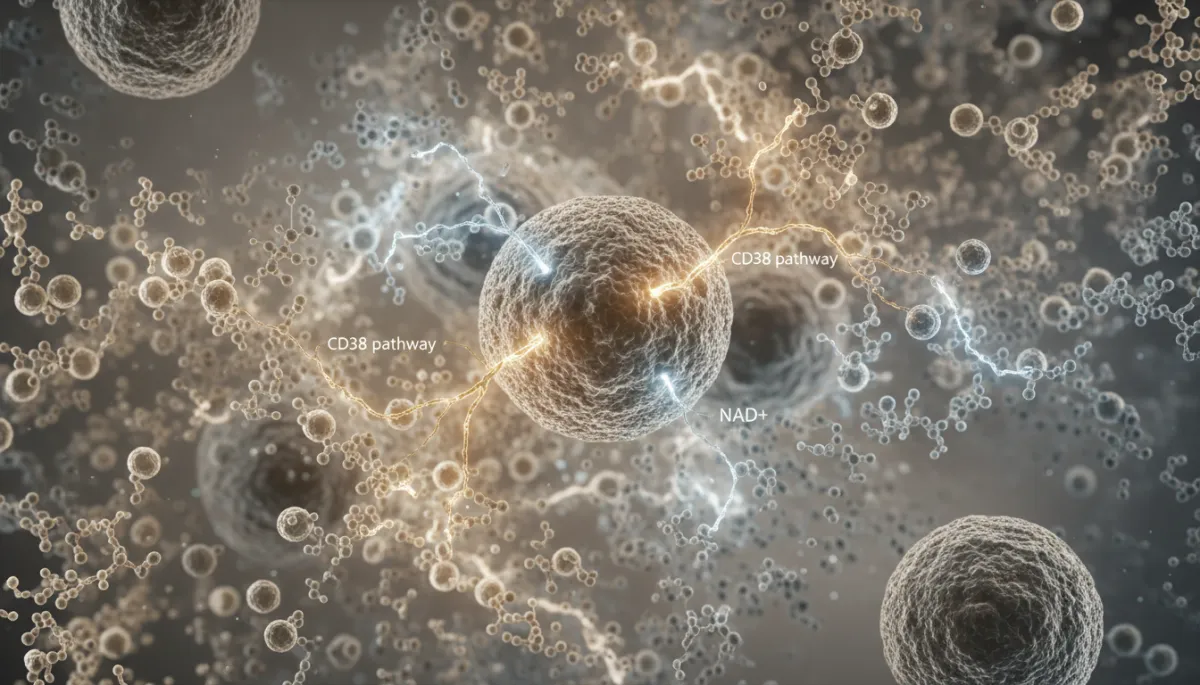
Senescent, CD38-expressing immune cells can drive chronic NAD+ loss and inflammaging.
Strategies to Support NAD+ Levels: Beyond Single-Molecule Thinking
Given the centrality of NAD+ to cellular health, it is unsurprising that strategies to bolster NAD+ are a cornerstone of modern longevity protocols. However, the 2026 systematic review of NAD+-related interventions highlights a crucial point: while many approaches reliably raise NAD+ biomarkers, translation into consistent, clinically meaningful outcomes in humans remains incomplete (Ageing Research Reviews, 2026). A prudent longevity strategy therefore integrates lifestyle foundations, targeted supplementation and, where appropriate, emerging delivery technologies, rather than relying on a single “silver bullet”.
Lifestyle Interventions: The First Line of NAD+ Support
Lifestyle measures remain the most evidence-based and broadly beneficial tools for supporting NAD+ metabolism and moderating CD38 activity. Several interventions stand out:
Regular physical activity: Exercise increases expression of NAMPT, a key enzyme in the NAD+ salvage pathway, and improves mitochondrial biogenesis. In animal models, exercise preserves tissue NAD+ and enhances sirtuin activity, while in humans it correlates with better metabolic health and muscle function across the lifespan.
Nutritional balance and mild energy stress: Caloric restriction and time-restricted eating can increase the NAD+/NADH ratio and activate sirtuin pathways. Diets rich in polyphenols (for example from berries, olives and green tea) may also modulate CD38 and sirtuin activity, although human data are still emerging.
Sleep and circadian alignment: NAD+ metabolism is tightly linked to the circadian clock. Irregular sleep patterns and chronic circadian disruption impair metabolic homeostasis and may reduce NAD+ availability. Prioritising consistent, high-quality sleep therefore indirectly supports NAD+-dependent repair processes.
Inflammation control: Managing cardiometabolic risk factors, oral health, visceral adiposity and environmental exposures can help reduce chronic inflammatory load. Because inflammatory signalling upregulates CD38, lowering baseline inflammation may protect NAD+ stores.
📌 Key Takeaway: Lifestyle interventions not only support NAD+ production but also address the upstream drivers of CD38 activation and inflammaging.
NAD+ Precursors: NMN, NR and NMNH in Longevity Protocols
Supplementation with NAD+ precursors remains one of the most widely used strategies in clinical and consumer longevity programmes. The best studied compounds are nicotinamide riboside (NR) and nicotinamide mononucleotide (NMN), with emerging interest in reduced derivatives such as NMNH. These molecules enter the NAD+ biosynthetic network at different points, but share a common goal: to increase intracellular NAD+ availability.
Nicotinamide Riboside (NR)
NR is a vitamin B3 derivative that is converted to NMN and then to NAD+ via the salvage pathway. Human trials consistently show that oral NR increases blood and peripheral blood mononuclear cell NAD+ levels, often by 40–100% over baseline, and is generally well tolerated (Cell Metabolism, 2020). However, the 2026 systematic review notes that improvements in functional outcomes – such as insulin sensitivity, muscle strength or cognitive performance – are variable and often modest. This underscores the current gap between biochemical engagement and proven clinical benefit.
Nicotinamide Mononucleotide (NMN)
NMN sits one step closer to NAD+ in the salvage pathway and has become synonymous with NMN longevity benefits in popular discourse. In rodent models, NMN supplementation improves glucose tolerance, vascular function, mitochondrial biogenesis and physical performance, while in some studies it modestly extends lifespan (Frontiers in Pharmacology, 2020). Human trials to date demonstrate robust increases in NAD+ biomarkers and encouraging signals in areas such as insulin sensitivity and fatigue in specific populations, but large, long-duration randomised controlled trials with hard clinical endpoints are still lacking.
From a longevity medicine standpoint, NMN appears biologically plausible and mechanistically aligned with healthy ageing, especially in individuals with metabolic or inflammatory burdens that may compromise NAD+ status. However, given the current evidence base, it should be framed as a promising adjunct to – not a replacement for – foundational lifestyle and risk-factor management.
NMNH and Next-Generation Precursors
Reduced forms of NMN, such as NMNH, are being investigated as potentially more efficient or stable NAD+ precursors. Early preclinical work suggests that NMNH may raise NAD+ more rapidly or to a greater extent than oxidised NMN, possibly with distinct effects on redox balance. However, human data are extremely limited, and regulatory frameworks are still evolving. For now, NMNH should be regarded as an experimental tool rather than a mainstream clinical intervention, albeit one that could expand the therapeutic palette in the coming years.
⚠️ Clinical Caution: Emerging reviews highlight that indiscriminate, long-term NAD+ boosting may carry theoretical cancer risks in certain contexts. Personalised risk assessment and medical supervision are advisable for high-dose or chronic use.
Liposomal Delivery and Novel NAD+ Administration Routes
One of the challenges in NAD+ therapeutics is ensuring that administered compounds reach target tissues in biologically meaningful concentrations. Oral NAD+ itself is rapidly degraded in the gut, so most interventions rely on precursors. To enhance bioavailability, manufacturers increasingly turn to liposomal delivery methods, encapsulating NAD+ precursors in phospholipid vesicles designed to protect them from digestion and facilitate uptake across the intestinal barrier.
While pharmacokinetic data for liposomal NMN or NR remain sparse, the general principle is supported by studies of other liposomal nutrients and drugs: encapsulation can increase plasma exposure and potentially improve tissue distribution. For clinicians, the practical implication is that liposomal formulations may allow lower nominal doses to achieve similar NAD+ biomarker responses, although rigorous head-to-head trials are still needed to confirm this in the context of longevity medicine.
Beyond oral routes, innovative technologies are emerging. A 2026 study described an ion-coupled transfersome complex (ICoN) for transdermal NAD+ delivery, which effectively penetrated porcine and human skin explants, reversed senescence signatures and improved mitochondrial function in cellular models (Materials Today Bio, 2026). Although this research is early and focused on skin ageing, it signals a future in which local or systemic NAD+ modulation might be achieved through non-invasive routes, complementing oral precursors and intravenous protocols currently used in niche settings.
CD38 Modulation: A Future Therapeutic Axis?
If rising CD38 activity is a major driver of NAD+ depletion in ageing tissues, then selectively modulating CD38 offers an attractive complement to precursor supplementation. Experimental CD38 inhibitors have been shown in animals to raise NAD+ levels, improve metabolic health and attenuate age-related functional decline (Frontiers in Pharmacology, 2021). In humans, monoclonal antibodies targeting CD38 are already used in oncology, albeit at doses and schedules designed to deplete malignant plasma cells rather than fine-tune NAD+ metabolism.
Translating this concept into longevity medicine would require a very different approach: partial, tissue-specific, or context-dependent inhibition aimed at reducing excessive NAD+ breakdown without compromising essential immune functions. Small-molecule CD38 inhibitors, or agents that modulate its expression in senescent and inflammatory cells, are therefore of considerable interest. For now, they remain largely in the preclinical or early translational pipeline, but the trajectory of research strongly suggests that “CD38 and longevity” will be a major theme in the next generation of interventions.
Future Prospects in Longevity Science: Towards Precision NAD+ Modulation
The emerging consensus from 2025–2026 research is that NAD+ biology is both more promising and more complex than early narratives suggested. On the one hand, preclinical data consistently show that restoring NAD+ can improve multiple facets of ageing physiology, from mitochondrial function and neuromuscular performance to cognitive resilience and cardiometabolic health. On the other, human trials, while confirming biochemical effects, have yet to demonstrate large, reproducible gains in lifespan or healthspan, and there are legitimate concerns about potential risks, including cancer promotion in susceptible individuals (Mechanisms of Ageing and Development, 2026).
Looking ahead, several trends are likely to shape the field:
Precision NAD+ profiling: More sophisticated assays of tissue-specific NAD+ pools, NAD+/NADH ratios and related metabolites will enable personalised assessment of who truly benefits from NAD+ boosting, and at what stage of life or disease.
Combination strategies: Integrating NAD+ precursors with senolytics, anti-inflammatory agents, exercise programmes and nutritional interventions may yield synergistic benefits, particularly by addressing the CD38–NAD+–inflammaging axis from multiple angles.
Tissue-targeted delivery: Technologies such as liposomal encapsulation, transdermal systems and organ-targeted nanoparticles could allow more precise modulation of NAD+ in vulnerable tissues (for example, brain or skeletal muscle) while minimising systemic exposure.
Context-aware CD38 modulation: Instead of blanket inhibition, future therapies may selectively dampen CD38 in senescent or chronically inflamed cells, thereby protecting NAD+ without impairing acute immune responses.
Practical Implications for Longevity-Focused Individuals and Clinicians
For now, how should the evidence around CD38, NAD+ and ageing inform practice? A pragmatic, professional approach might include the following principles:
Anchor interventions in lifestyle: Exercise, anti-inflammatory nutrition, sleep optimisation and risk-factor control remain the bedrock of healthy ageing and indirectly support NAD+ homeostasis and lower CD38-inducing inflammation.
Use NAD+ precursors judiciously: NR and NMN can be considered as adjuncts, particularly in older adults or those with metabolic or inflammatory burdens, with expectations framed around biomarker improvements and modest functional gains rather than guaranteed longevity benefits.
Monitor and personalise: Where resources allow, tracking metabolic, inflammatory and functional markers over time can help tailor dosing and evaluate real-world impact, rather than assuming benefit from NAD+ boosting alone.
Stay alert to evolving evidence: As larger, longer-term trials report and as CD38-targeted therapies mature, best practice in longevity medicine will likely shift. Remaining open to updating protocols is essential.
Conclusion: CD38, NAD+ and the Next Chapter of Longevity Medicine
The story of CD38 and NAD+ encapsulates the promise and complexity of twenty-first-century longevity science. On one side, NAD+ is an indispensable orchestrator of energy metabolism, DNA repair and stress responses, with robust preclinical evidence linking its restoration to healthier ageing trajectories. On the other, enzymes such as CD38 remind us that biology rarely offers unidirectional levers: the same pathways that protect us in youth can contribute to decline when chronically activated in later life.
For clinicians, researchers and individuals invested in healthy ageing, the key is to move from simplistic narratives – “NAD+ always declines with age” or “more NAD+ is always better” – towards a more nuanced, personalised framework. That framework recognises the role of cellular senescence, inflammaging, CD38 activation and mitochondrial resilience, and deploys a blend of lifestyle optimisation, carefully selected NAD+ precursors, emerging delivery systems and, in time, targeted CD38 modulation.
As larger human trials and more refined technologies come online, we can expect clearer answers about who benefits most from NAD+ interventions, at what dose, and in combination with which other therapies. Until then, the most responsible position is one of informed optimism: acknowledging the compelling mechanistic rationale and early data around the CD38–NAD+ connection, while grounding practice in evidence-based foundations and a realistic appreciation of what is – and is not yet – proven in the quest for longer, healthier lives.
The key to optimising for Longevity and performance is to start with a consultation and testing to find what is optimum for you. Book your initial appointment here: https://omicslongevity.com.au/contact